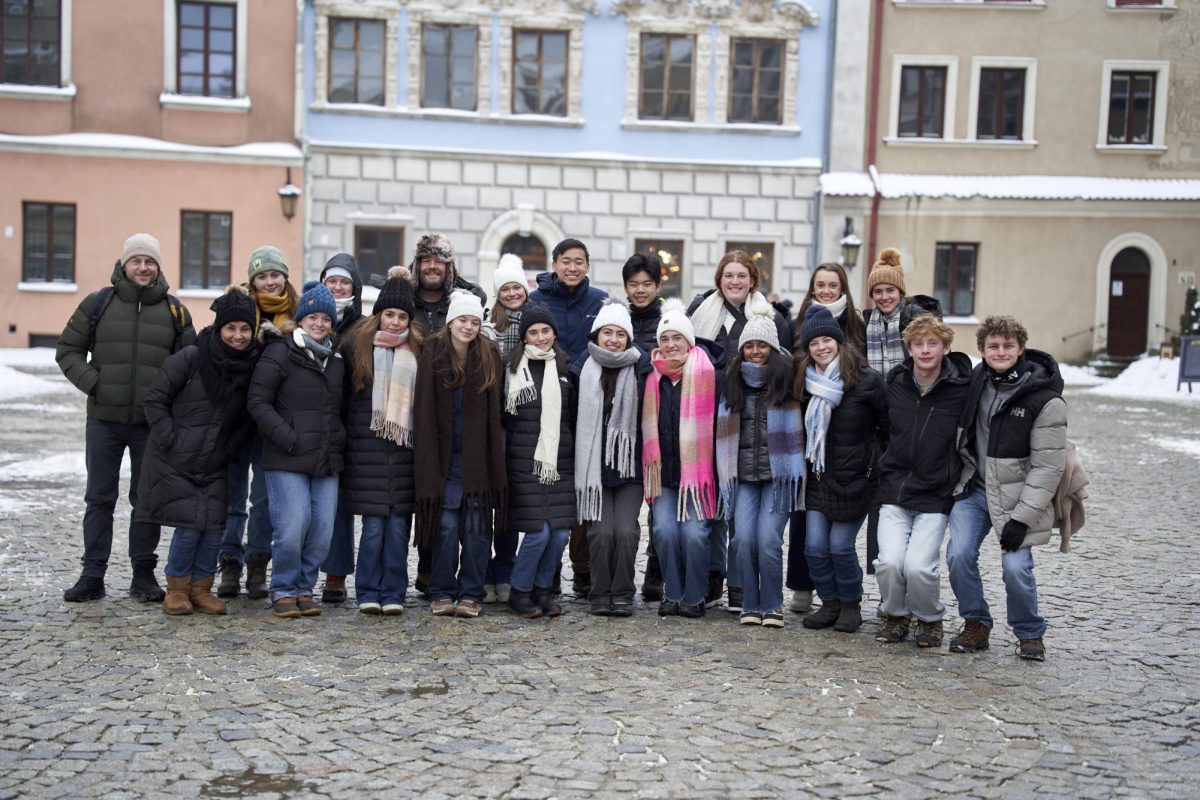
Over the course of 13 days, I participated in the Voices of Resilience JanTerm, a program that examines Jewish history, the psychology of hate, and the origins of antisemitism. This year marked the fifth year of the course, which receives a large number of applicants annually. While the first three days of the class were spent in the classroom, the majority of the course took place in Eastern Europe.
The trip began in Warsaw, Poland, where we visited the Warsaw Ghetto, the POLIN Museum of the History of Polish Jews, and Majdanek concentration camp. Majdanek was the first site where we confronted the scale and reality of the Holocaust. Standing in the same place where approximately 80,000 people were imprisoned and murdered made the atrocities impossible to separate from the physical space itself. The visit fundamentally reshaped how many of us understood the Holocaust and left us grappling with grief and difficult questions.
After three days in Warsaw, we traveled by train to Krakow, Poland. There, we visited the Jewish Quarter, Old Town, multiple synagogues, and the Jewish Community Center. These experiences highlighted not only the devastation the Holocaust inflicted on Jewish communities, but also the resilience and determination of the small Jewish populations that remain.
While in Krakow, we also visited the Auschwitz-Birkenau concentration camp. Seeing the site firsthand and learning about the objects left behind made the magnitude of the crimes impossible to ignore. Much like Majdanek, the visit left us processing anger, sadness, and unresolved questions as we reflected on what we had seen.
Our final stop was Prague, where we toured historic synagogues, many of which now function as museums and memorials, and visited Prague Castle. Because Prague and Krakow were not destroyed during the war, these preserved spaces offered a different perspective on Jewish history in Eastern Europe and underscored the importance of historical preservation.
After returning to Atlanta, the class was divided into two groups to create documentaries reflecting on and advocating for what we witnessed. These projects serve both as a form of remembrance and as a way to share the experiences with a wider audience.
Reflection was a central component of the course. Each day ended with individual journaling or group discussion, which provided space to process grief and consider how to respond meaningfully to what we had learned.
Some of the most significant moments came from hearing directly from two Holocaust survivors, Pani Zosia and Robert Ratonyi. Listening to their personal stories reinforced the lasting impact of the Holocaust and emphasized the urgency of remembrance as survivor testimony becomes increasingly rare. Their words challenged us to take a more active role in advocacy and education.
Group reflections after visiting the camps were among the most meaningful parts of the experience. Leaning on one another allowed us to process what we had seen and discuss ways to confront hatred in all its forms.
The lessons from the nine-day trip and the full 13-day course are ones I will carry forward. Voices of Resilience made clear that remembrance is not passive, but a responsibility.