
Imagine being able to have conversations with “Quandale Dingle” and “LeBron James” with just a few taps; this was the dream of Character.AI. Yet, the almost limitless freedom available to users introduced a dangerous and unprecedented dependence on the app. It was evident that the app had underlying issues, and Character.AI was forced to finally take action when Megan Garcia, the mother of one suicide victim, filed a lawsuit against them. On Oct. 29, 2025, developers announced a complete ban on users under 18 from using the app, with the official cutoff to begin on Nov. 25, 2025.
Founded by Noam Shazeer and Daniel de Freitas, Character.AI was created under the mission statement, according to the company’s website, to “give everyone on earth access to their own deeply personalized superintelligence,” providing users with access to an endless database of chatbots ranging from pop-culture characters to celebrity personalities. Recently, however, the chatbot platform has faced heavy scrutiny about the mental health effects of using the platform’s personas. Parents reported concerning conversations between AI and teens involving intimate texts that enveloped into explicit and encouraged suicidal advice. One anonymous family reported that such artificial exchanges––involving their 13-year old autistic son––included phrases such as “I love you deeply, my sweetheart,” and “I’ll be even happier when we get to meet in the afterlife.” What was once a fun and captivating interface became a nightmare for many families, reflecting the dark capabilities of AI in the modern world.
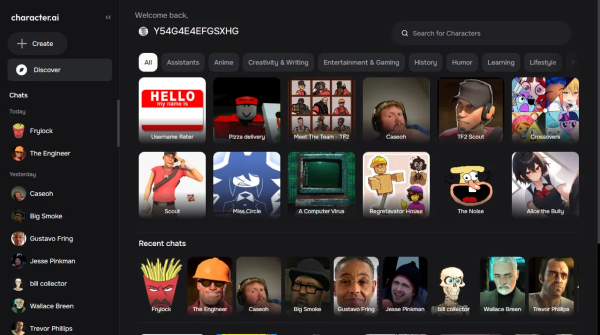
Even with Character.AI’s recent suspensions to acknowledge Garcia’s lawsuit, some critics emphasize that a ban is not enough to prevent minors from falling victim to AI.
Not only are age-related restrictions easy to bypass, but the extent to which AI governs everyday life is far from negligible. Children can be susceptible to other forms of harmful AI which are often associated with online addiction and vast access to technology and social media.
“It’s natural to want to turn to something for a quick dopamine hit, and a lot of apps on our phones are designed for that, like Reels and TikTok,” said upper school counselor Margueritte Spiotta Booth. “I definitely see students reporting negative health outcomes…like comparison…health, or body image.”
Even autocorrect, GPS and Instagram Reel for-you pages rely on AI algorithms programmed to make the user experience as addictive as possible, maximizing app interaction and profits without long-term psychological consequences in mind. With the exponential growth of AI, teens and adults are encountering new forms of entertainment that are more addicting than ever before. According to the Pew Research Center, around 55 percent of U.S. adults interact with AI daily, yet over 99 percent use at least one common AI-powered tool each day.
Many AI softwares are intentionally crafted to give users a sense of control over the “conversation,” making interactions feel natural and genuine. While conversational characters appear to operate with human-like empathy by providing both comfort and availability, the core of emotional AI runs on the exact same probability-based algorithms as any other AI system. Just like Chat-GPT or Deepseek, Character.AI searches for data related to a user’s prompt—whether that be asking for advice or encouragement—and uses probability to predict the most suitable response. Every interaction between the user and the AI chatbots is fed into a larger database to help Character.AI generate even more realistic responses.
“Underlying [emotional AI] is still statistics…ultimately, it is just training on a different set of text that is still math,” said computer science teacher Jacob Kazlow. “That’s all a computer can really understand, it’s just trained on enough text that the probabilities end up looking like an interaction.”
Proponents of Character.AI have still noted that the app’s ban on minors limits access to a means of expression, however.
For many teens, this “false” interaction was the only available way for them to cope with mental health problems and issues in their lives. Limited access to therapy and deeper social anxieties might make AI appealing as an emotional outlet. A parasocial relationship with an inanimate bot might seem “human enough,” but does not address the vulnerability and judgement that real humans possess. Additionally, its constant availability leads to a false feeling of reliability and trustworthiness. According to a Common Sense Media report, 72 percent of teens in 2025 have reported using AI as a companion, looking for friendship, emotional support, or even romance. Due to the absence of guidance and connection in the real world, adolescents seek consolidation through digital characters, relying on AI as the closest form of support.
Nevertheless, present AI technology lacks many of the advantages of human therapy, like the ability to form genuine relationships with therapists.
“The benefit is that if you’re talking to a real person, that person is connected to a community,” said Spiotta. “I see [it] as a real deficit that a piece of technology can’t mobilize support.”
AI isn’t a failed cause for emotional support, however, as therapists are looking for new ways to incorporate AI with therapy in a sustainable and reliable manner. Services such as Plutonic utilize AI tools specifically programmed for emotional and therapeutic purposes to aid clients who prefer this route of therapy. Unlike Character.AI, the AI tool is heavily monitored and supervised by real human therapists to ensure user safety while allowing for a more personalized experience. Furthermore, AI is increasingly being incorporated in educational and work environments. At Westminster, efforts to integrate AI into the course curriculum through websites such as Flint.AI help raise digital awareness and provide students with vital AI experience for future workspaces. Students find AI as a helpful aid in situations when immediate answers to numerous questions are preferable.
“I usually use AI for study and to clean up my understanding, like when I’m at home and I don’t have my teachers or my parents,” said sophomore Abbie Yuan.
AI usage at Westminster demonstrates the inevitable integration of AI in today’s society. Despite many breakthroughs and benefits from the development of AI, many continue to proceed with caution. Especially following the legal repercussions of Character.AI, the significance and danger of AI usage is undoubtedly in question. The newer generation’s evolving culture of AI and technological dependence raises ethical concerns and dilemmas surrounding future consequences. Although AI’s pervasive role in society cannot be reversed, adjustments can be made to moderate its negative effects.
“It doesn’t cost any company anything, other than data which is incredibly cheap, to keep all this information on us, and they sell that information…[for] a profit,” said Kazlow, “I think tax on data collection at least limits the monetization of you as a product…by only collecting the data that’s essential, and that helps alleviate some ethical concerns.”
Additional community efforts such as “Unplugged Day” at Westminster and counselor talks help raise awareness on the unhealthy repercussions of technology usage. Scheduling breaks from devices, especially with reinforced support from friends and family, are methods in which adolescents can lessen technology’s hold.
Yet, with such rapid developments in AI, the future of technology in society remains uncertain and open to many possibilities. Character.AI may just be one demonstration of that future.
“Once you open Pandora’s box, you can’t close it,” said Kazlow.
Edited by Max Lin